
In my previous blog post, 6 Reasons Why The Bible Is Reliable and Historically Accurate, strong evidence was presented to support that position.
In this follow-up, I will present what is even stronger evidence regarding the reliability and historical accuracy of the Bible. My ultimate goal is to provide proof, through prophecy, that the Bible is God’s Word.
Much of the Bible is Prophecy
What is Prophecy?
Prophecy is to foretell beforehand. It is a prediction, a declaration of something to come; history written in advance. Because only God knows future events with certainty, no being but God, or someone informed by Him, can speak real prophecy.
Unknown to those just casually familiar with Bible, or not familiar at all, is the fact that the Bible is approximately one-third prophecy. That is a significant number when examining the specifics and time frame involved.
What will be presented here is not solely for academic purposes but will hopefully be useful information and knowledge to convince the skeptical and enhance the trusting that the Bible is God’s Word.
This is a major area that seems to be largely overlooked when examining the veracity of the Bible. A thoughtful close look at the events presented here should give any honest skeptic pause in considering their position.
I will present this topic from 6 perspectives:
1) Believers
2) The Gospel
3) The Messiah
4) Israel
5) The Apostate (False Church)
6) Christ’s Return
These will be covered in a three-part series, two perspectives in each.
In this particular blog post, we are covering the perspective of believers and the Gospel.
Perspective 1: Believers (The Church)
When we hear the word “church” today, most people likely associate that with a building or denomination. That is not a biblical representation or understanding of “church.”
The word “church” is a translation of the Greek word ekklesia, which is defined as “an assembly” or “called-out ones.” The root meaning is not of a building but of people. The early believers in the first century often met in individuals’ homes. Romans 16:5a says, “Greet the church which is in their house.” (emphasis mine). There were very few large buildings to gather in like we see today.
In that Romans 16:5 passage, the church seen not as a physical structure, but a body of believers.
The church is body of Christ, of which He is the head. Ephesians 1:22-23 says, “And He put all things in subjection under His feet and made Him head over all things to the church, which is His body, the fullness of Him who fills all in all.”
The body of Christ is made up of all who have received Jesus Christ from the day of Pentecost (Acts 2) until Christ’s return. What does this have to do with prophecy and why is it important?
Because the very existence of multiple millions today who have a personal relationship with Jesus the Christ is itself the fulfillment of prophecy. That is most significant. God foresaw this and had the prophets write it down. It didn’t just happen.
The Church was Prophesied Throughout the Old Testament
Remembering the definition of Prophecy as the foretelling of future events beforehand, we see numerous specific examples of God’s prophetic Word being spoken thousands of years in advance.
There are so many specific ancient prophecies in the Bible that have already been fulfilled, and books have been written about them. Suffice it to say, I will only be “scratching the surface” in this blog.
I realize that the events covered here aren’t that much of interest to us today, though they should be as will be shown as we move forward. The point is for us to see how precisely prophecy was fulfilled, thus confirming the trustworthiness of the Bible, which is God’s Word.
We could go all way back to the book of Genesis and move forward from there, but for obvious reasons we won’t. I will point out, however, God’s promise in Psalm 22:27 where David said, under inspiration of the Holy Spirit, “The whole earth will acknowledge the Lord and return to him. All the families of the nations will bow down before him.”
The first two perspectives mentioned above will be covered in this part.
Almost half the Books in the Old Testament,17 of the 39, are prophetic books, inspired by God (Gr. literally “God-breathed”, 2 Timothy 3:16) through the prophets. All of them were speaking specifically to the nation of Israel, the people group God chose to bring the Messiah through (We hope to cover that in another blog or video).
Malachi
Malachi (means messenger), the last book in the Old Testament, was the last of these prophets. In Malachi 1:6,10-11, God says to Israel that He did not want their offerings anymore because they despised His name, had corrupted and perverted the truth He taught them. In essence, He said they were so far from Him they didn’t even know what their problem was.
That was God’s last message through a prophet to the Jewish people. It is in that content that God declares He will make His name great among the Gentiles, the heathen (v.11). That must have been shocking to the Rabbis because they of course were the “chosen” people.
How is that going to come about? How is God going to “make His name great among the Gentiles”? That is a tremendous unlikely prophecy.
Psalm 22
Psalm 22 is one of the places in the Old Testament where we get an insight as to how this was to come about. This is a prophetic psalm that speaks of the crucifixion of Jesus and gives us a look into His generation.
How do we know that? Because these words were spoken by Jesus on the cross (Compare Psalm 22:1 with Matthew 27:46 and Mark 15:34).
In 22:30, the NLT translation puts it this way, “Our children will also serve Him. Future generations will hear about the wonders of the Lord.”
Several of the verses in Psalm 22 are quoted in the New Testament and clearly apply to Jesus’ death on the cross:
- Psalm 22:7 with Matthew 27:39 and Mark 15:29
- Psalm 22:8 with Matthew 27:43 and Luke 23:35
- Psalm 22:15 with John 19:28
- Psalm 22:16 with Luke 24:40; John 20:20, and 26-27
- Psalm 22:18 with Matthew 27:35, Mark 15:24, Luke 23:34 and John 19:23-24
- Psalm 22:22 with Hebrews 2:11-12.
I am aware that some scholars question this Psalm as fulfilled prophecies relating to Jesus’ crucifixion on the cross. But it is interesting that there is almost unanimous consensus by well credentialled scholars that the man Jesus, did in fact die by crucifixion at the hands of the Romans during that period as the Bible states.
So, the question then becomes, which is more plausible? David being inspired by God to utter these words which vividly portrayed Jesus’ crucifixion about 1,000 years beforehand, or was it merely coincidental?
But not just that. Some of the words of David spoke, dealt with incidents surrounding the crucifixion scene itself that Jesus had no control of, i.e., verses 7, 8,16 and 18 with the New Testament comparisons. It would seem if reviewing this objectively, David was speaking prophetically, perhaps not even realizing it was prophetic at that time, about the future crucifixion of the Messiah.
There was an approximate 450-year period of silence during which God did not speak to His people through any prophet after Malachi.
Isaiah
However, we should go back about 360 years before Malachi, around 760 B.C., to see what God prophesied through one of the major prophets in Israel, Isaiah. It is important to pay attention to what God prophesied through him because it helps us see God’s plan for all humankind today. That is huge!
Isaiah (Yahweh is salvation) is regarded as one of, if not the greatest of the Old Testament Prophets because he is preeminently the Prophet of redemption (i.e., the forgiveness of sins by the death and suffering of Christ).
In 1947 a discovery occurred in Qumran, a village about twenty miles east of Jerusalem on the northwest shore of the Dead Sea. This was a huge archeological and historic discovery because ancient scrolls were found in ceramic pots in caves which contained thousands of scroll fragments dated from the third century B.C. to A.D. 68.

A copy or portion of nearly every Old Testament book was found there. All of them created nearly one thousand years earlier than any previously known biblical manuscripts, including the complete scroll of Isaiah. The Dead Sea Scrolls as they have come to be known, comprised a vast collection of Jewish documents written in Hebrew, Aramaic, and Greek. The Isaiah scroll is on display at the Israel Museum in Jerusalem, which I saw when we visited there some years ago.
The Dead Sea Scrolls were a remarkable discovery not only because of what they contained and the excellent condition they were in, having remained hidden for so long (over 2000 years), but also having minimal differences between the manuscripts that had previously been discovered and those at Qumran.
Isaiah’s prophecies are especially important because he foretold of the coming Messiah, hundreds of years before Jesus was born (Isaiah 7:14; 9:1-7; 11:2-4; 53:4-7, 9, 12). The Gospels quote more from Isaiah than any other Old Testament prophet.
Most of chapters 40-54 in Isaiah are prophecies about the coming Messiah, who opened the door for the church age which we are now in. Isaiah 53 is especially important because in it the prophet writes in detail about the sufferings Christ, the Messiah would experience. He says this repeatedly in other passages as well. This was 700 years before Jesus came to earth.
I am aware, some liberal “scholars” have doubts about anything that indicates supernatural inspiration of the Bible, particularly regarding Isaiah. However, to discount the reliability of Isaiah, they would then also have to disregard the inspiration given to Matthew 3:3, Luke in Luke 3:4, Paul in Romans 10:16, 20, and John in John 12:38-41, all of whom quote Isaiah, thereby affirming his writings.
Jesus Himself quoted from Isaiah in Mark 7:6-7, and especially in Luke 4:16-20 when He began His public ministry in Nazareth. He read Isaiah 61 from the scroll and stated that it was referring to Him and was fulfilled that day. After explaining further, the people became so upset with Him that they tried to force Him over the edge of the cliff outside the town and kill him. Wow.
So, the fact that Jesus Himself affirmed Isaiah should be proof of its credibility. However, it’s clear that if the very words of Jesus are not enough for some, then they will not be convinced no matter what.
Related: In the Beginning God: A Logical Argument for God’s Existence
The Beginning of the Church
The history and development of the “church” began “when the day of Pentecost had fully come, they were all together in one place” (Acts 2:1).
The first church was all Jewish and they could not believe the Gentiles were to have part in this salvation. In Acts 10:9-43, God spoke to Peter in an unusual way, through a trance, that the Gentiles were to be partakers of this salvation. Peter couldn’t believe it and after his experience in going to Cornelius and the other Gentiles in his household who became believers, when Peter got back to Jerusalem the Jews criticized him. They couldn’t understand it. If they had read their own scriptures they should have.
The Jewish religion then, as well as now, believed in strict adherence to the Mosaic Law, including hundreds of others they added. But the law then, as well as now, could not save anyone because no one could keep it (Romans 3:20,28).
So just logically, the people in the Old Testament could have known there was something defective about that Covenant for them to have to continually make animal sacrifices repeatedly. That should have proved the Law was inadequate as far as establishing a right relationship with God.
Perspective 2: The Gospel
What is “the gospel?”
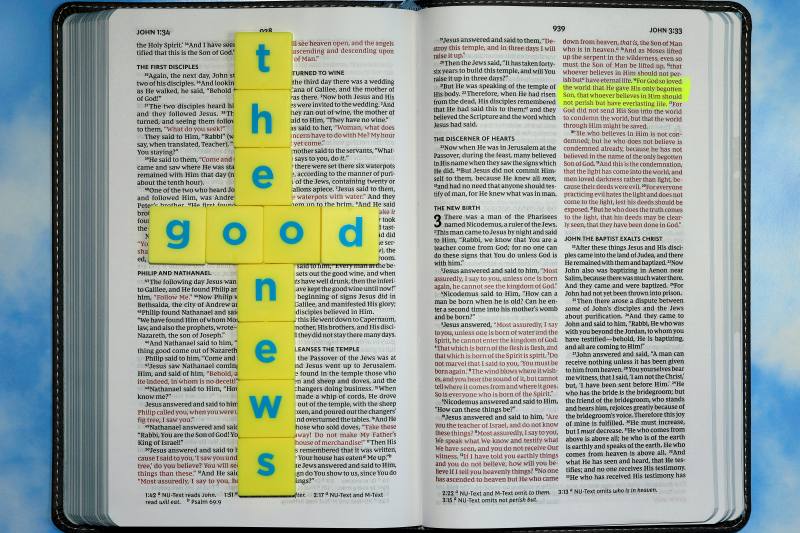
The word gospel literally means “good news” and it occurs 93 times in the Bible, exclusively in the New Testament. Why is it important to note that it only appears in the New Testament?
Because that substantiates the fact there was not any good news whatsoever for humanity, with respect to God, until Jesus came into this world to pay the penalty for our sins.
Good News?
For us to understand or even get a glimpse of what is so “good” about this news, we should first focus on, the goodness and holiness of God, that is, Who He is. That is virtually an impossible task because in our humanness, with limited finite minds, we cannot phantom the depth and enormity of who God really is. Trying as hard as we might, we will always come up short in comprehending His greatness.
Psalm 145:3 puts it this way, “Great is the Lord and greatly to be praised, and His greatness is unsearchable” (incomprehensible to man) (emphasis mine). It’s immeasurable.
Many people today throw around the word “awesome” for ordinary, common, routine things that are far from “awesome” when compared to God and His creation. The word Awesome means to be “in awe” of something or someone. It’s to have a reverential fear.
Another aspect and characteristic of God which we really cannot phantom is His holiness. That’s what makes this gospel, “good news”, even great, because again, we cannot phantom what that means.
God is completely Holy. The problem in trying to comprehend what that means as humans, is we think of ourselves as basically “good people.” Well, that is a relative term. The question is “good” compared to who or what?
You or I might be “good” compared to others around us, i.e., friends, family, neighbors, etc. Compared to God however, no one is “good.” In fact, it states in Jeremiah 17:9, “The heart is deceitful above all things, and desperately wicked (sick), who can know (understand) it.”
Anyone who thinks that people in general are basically “good”, should just look at history a little and see the degree of atrocities, cruelty, and devastation humans have done to one another. We don’t have to look at large scale issues like war, etc., but just individual personal everyday crimes.
Related: Why Humanity Needs Redemption: God’s Holiness, Justice, and Love
This is Incredibly Good News!
So why is this gospel so incredibly good, almost too good to be true news? Because all of humanity, compared to Almighty God, who is totally and completely holy, perfect in every way, chose to do something for us, that we couldn’t do for ourselves.
Obviously, there is much about God we just do not understand and won’t on this side of things. That is to be expected if we consider that he is self-existent, without beginning or end, and our very existence depends on Him. To say there is a vast difference between us and Him is a gross understatement.
The Bible is very clear that, “all have sinned and continually fall short of the glory of God” (Romans 3:23) (emphasis mine), it further declares, “The wages of sin is death, but the free gift of God is eternal life in Jesus Christ our Lord” (Romans 6:23) (emphasis mine).
I don’t know how it could be any clearer than that. All of humanity deserved the “death penalty” i.e., eternal separation from God, but because Jesus came to earth and sacrificed His life to pay the penalty for our sin, we can have eternal life if we receive that gift.
The entire Old Testament pointed to the Supreme Sacrifice that was to come. Leviticus 17:11 states, “for the life of the body is in its blood. I have given you the blood on the altar to purify you, making you right with the LORD. It is the blood given in exchange for a life, that makes purification possible.” (emphasis mine)
That is the central statement about the significance of blood to God in the sacrificial system. A sacrifice is the offering of something precious for a cause or a reason. Making an atonement is satisfying someone or something for an offense committed.
I realize there are many people who do not think they are that “bad” of a person compared to some others to require such a sacrifice on their behalf. That reasoning may be logical from a human perspective. But if we could see ourselves from God’s perspective, we could then possibly begin to realize the depth of the depravity and how utterly woeful the human condition is, apart from the new birth and life in Christ. At that point, the price that had to be paid, Jesus’ life, makes sense. In looking at the world we live in, sin doesn’t appear to be that big a deal to many.
However, the law God gave to Moses required animal sacrifices to atone for sin, all sin had to be atoned for (Leviticus 4:3, 13, 22, 27). There were large number of sacrifices that were repeated year after year in Israel, but they were only pictures of the true sacrifice of Jesus yet to come (Hebrews 10:1).
I am aware there are people who take issue with God over the animal sacrifice requirement. It seems they value animal life more than humans. Humans were created in the image and likeness of God not animals (Genesis 1:26-27). That’s not to say we shouldn’t care about animals. But if we place a higher value on animals than humans, which it appears we do when looking at the number of innocent human beings killed every year, that seems very misplaced.
If those animal sacrifices had truly purged the people, then they wouldn’t have had to offer any more, year after year. The Old Testament animal sacrifices could not make them right with God; therefore, they were continually making sacrifices for sins (Hebrews 10:2-4).
But now that Jesus has offered Himself as the perfect sacrifice, the Father is no longer requiring a sacrifice from us. Jesus has fulfilled the requirement once, for all, for all time (Hebrews 9:12, 10:10, 14).
That is the Incredibly Good News! That is The Gospel. For all those who will Receive It.
Related: Judaism vs Christianity vs Islam
Conclusion: Prophecy Proves the Bible is God’s Word
Many people are asking questions about the future of humankind on this planet seemingly as never before. Because of all the chaos, wars, turmoils, etc., there are legitimate concerns for the thinking mind. The Bible is really the best place to find answers for those open to receive what God has communicated to us in His Word.
The numerous prophecies in the Bible that have already been fulfilled should be clear evidence of the credibility, reliability, and veracity that the Holy Bible is in fact God’s Word. I have just barely “scratched the surface” of only two of the six topics regarding prophecy as proof. The prophecies in the Bible are not like those in the past by Nostradamus, Jeanne Dixon or others, that were so vague and general they could be made to fit in any situation.
Almost every prophecy recorded in the Bible is very precise and so specific that when fulfilled their uniqueness is unmistakable. Next, on my next blog post, we will cover two other very important prophetic topics, Fulfilled Prophecies about Jesus, The Messiah, and Israel, which should provide further credible proof of the divine inspiration of the Bible.
